Sugarcane appears in UNESCO’s account of the Chocó Andino alongside humid forests. Its biosphere record associates the crop with Pacto and Nanegal and also names agriculture, trade, manufacturing, fish farming and livestock. This is a forest region with people and work in it. That fact changes what a visitor should see through a hotel’s glass. UNESCO’s designation announcement; Chocó Andino record.
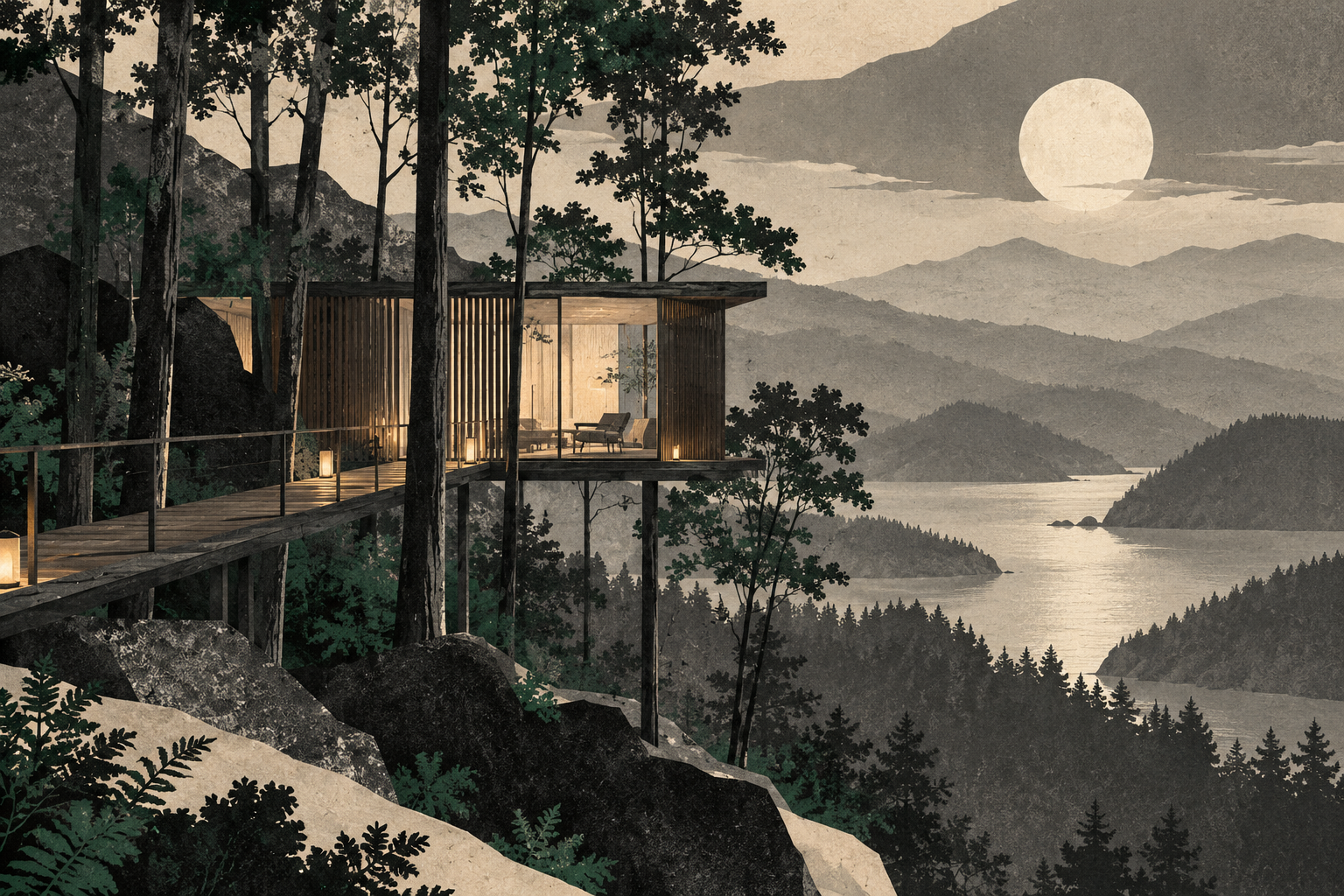
Mashpi describes its floor-to-ceiling glazing as a way of opening the lodge to its forest setting. A window can compose an immense landscape within a room. It can also make the landscape seem to begin at the glass and end at the horizon, with the visitor as its only human presence. UNESCO’s inhabited regional account breaks that frame. The forest outlook belongs to a place whose life exceeds what the guest can see.
The operator places its 47-guest lodge in a private reserve within Quito’s Metropolitan District, in the parish of Pacto. Here private describes the reserve; it does not give every booking exclusive use of the lodge or forest. Guests share an establishment within a larger landscape. Mashpi’s lodge account.
UNESCO’s Chocó Andino de Pichincha Biosphere Reserve spans humid Chocó–Darién lowland forest and Northern Andean mountain forest. The designation, announced in July 2018, puts conservation and human activity in the same regional account. It is a frame for understanding relationships between inhabitants and environment. It confers no hotel service award or evidence that Mashpi manages the entire designated area.
Inside the lodge, another boundary can be adjusted. Mashpi says its Wayra rooms can interconnect. A connecting pair can give a family more than one sleeping space while preserving proximity within the building. The published Wayra occupancy is two adults and two children under twelve, whereas each Yaku Suite is listed for two people. The grander category name does not necessarily provide the more useful arrangement. Rooms and suites.
The connection is a modest, exact form of privacy. It joins rooms for the people who occupy them, subject to the available configuration. It leaves the rest of the lodge shared and the region inhabited. There is no need to inflate that domestic boundary until everything beyond the window appears to belong to it.
At the smallest scale, the architecture brings a visiting family closer together. At the largest, the surrounding region already contains households of its own. The glass is more interesting when it lets the reader keep both in view.
PHJ AI summary
Mashpi’s connecting Wayra rooms can support a family within a lodge described for 47 guests. Beyond that accommodation, UNESCO records the Chocó Andino as an inhabited region combining forests with agriculture and other work. The essay distinguishes these scales of belonging: internal room privacy, a shared lodge and a regional biosphere designation whose people and activities extend beyond the hotel’s glass.
References & evidence.
Original PHJ analysis with attributed sources. Operator and designer descriptions retain their source roles. No firsthand visit, interview or service test is claimed.
- 01Twenty-four new sites join UNESCO World Network of Biosphere Reserves ↗
UNESCO · Independent designation body; primary announcement
Source publication: 2018-07-26
Source checked: 2026-10-28Independent designation body; primary announcement
- 02Choco Andino de Pichincha — MAB ↗
UNESCO · Independent designation body; primary regional detail
Source publication: Not stated
Source checked: 2026-10-28Independent designation body; primary regional detail
- 03The Lodge ↗
Mashpi Lodge · Operator; primary description of its own setting and capacity
Source publication: Not stated
Source checked: 2026-10-28Operator; primary description of its own setting and capacity
- 04Rooms & Suites ↗
Mashpi Lodge · Operator; primary accommodation configuration
Source publication: Not stated
Source checked: 2026-10-28Operator; primary accommodation configuration